Selected Research
Regional Labour Market Diagnostic for Recovery Programming

Applied labour market assessment focused on workforce gaps, sectoral recovery potential, and human capital constraints in war-affected regions of Ukraine.
- Role
- Lead analyst; development of analytical framework and employer survey methodology.
- Approach
- Combined secondary statistical analysis with employer survey data and sectoral assessment to identify skills shortages, employment barriers, and recovery bottlenecks.
- Key Focus
- Sector-specific workforce gaps; training needs; institutional constraints affecting local economic recovery and employment growth.
- Impact
- Evidence base for programme design, investment targeting, and labour market interventions in recovery-oriented projects.
Tracer Study 2025: Performance Indicators and Transition Outcomes in VET

Expanded tracer study assessing employment transitions, programme effectiveness, and performance indicators for vocational education reform in Ukraine.
- Role
- Lead analyst; refinement of monitoring framework and indicator system for CVET institutions.
- Approach
- Graduate follow-up surveys, comparative cohort analysis, outcome benchmarking, and evaluation of target achievement indicators.
- Key Focus
- Employment sustainability, quality of transition, regional disparities, and institutional performance measurement.
- Impact
- Strengthened results-based monitoring architecture and informed policy adjustments in vocational education and training.
Tracer Study of VET Graduates and Skills Transition Outcomes

Large-scale tracer study assessing employment outcomes, transition pathways, and effectiveness of support instruments for VET and CVET graduates in Ukraine.
- Role
- Lead analyst; development of tracer study methodology, indicator framework and analytical model.
- Approach
- Graduate surveys, employer feedback, outcome indicators, and comparative analysis of employment trajectories and programme participation.
- Key Focus
- Employment rates, quality of transition, skills mismatch risks, and performance indicators for vocational education reform.
- Impact
- Evidence base for adjusting VET policy instruments and strengthening results-based monitoring of skills development programmes.
Labour Market of Ukraine 2022–2023: State, Trends and Prospects

Comprehensive assessment of Ukraine’s labour market transformations under wartime conditions, analysing demographic losses, migration, mobilisation, sectoral disruption and enterprise capacity constraints.
- Role
- Co-author and lead analyst; design of analytical framework and employer survey component.
- Approach
- Integrated macroeconomic and demographic analysis with administrative labour statistics and a large-scale employer survey (2023), including sectoral and regional disaggregation.
- Key Findings
- Structural reduction of labour supply; training investment constraints among SMEs; emerging regional and sectoral mismatch risks.
- Impact
- Evidence base for recovery planning, skills investment prioritisation, and coordination between employment services, employers and education providers.
System for Assessing Professional Demand Trends in Local Labour Markets
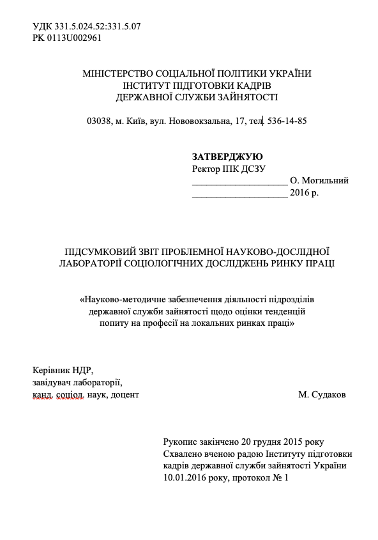
At the time of the research, Ukraine lacked a unified methodological framework for assessing professional demand trends at the local level, limiting the anticipatory capacity of the State Employment Service.
- Role
- Head of Research; design of methodological and institutional framework.
- Approach
- Employer surveys, expert interviews and focus groups; cluster analysis of regional labour markets; regression-based forecasting; leading unemployment indicator.
- Outputs
- Monitoring system for local labour markets, including regulatory documentation, data collection instruments, analytical procedures, and training modules; piloted in selected regions.
- Status
- Registered scientific research (PK 0113U002961). Approved by the Academic Council (2016).